
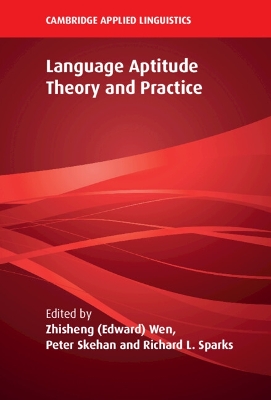
Language Aptitude Theory and Practice
 portes grátis
Language Aptitude Theory and Practice
Skehan, Peter; Wen, Zhisheng (Edward); Sparks, Richard L.
Cambridge University Press
04/2023
524
Dura
Inglês
9781316513996
15 a 20 dias
Descrição não disponível.
Preface and acknowledgements; 1. Language aptitude research: from testing to theory and practice Zhisheng Wen, Peter Skehan and Richard Sparks; Part I. Revisiting and Refining Aptitude Tests: 2. The MLAT-Elementary: history, adaptations and current uses Daniel Reed and Charles Stansfield; 3. Testing language aptitude: LLAMA evolution and refinement Vivienne Rogers, Paul Meara and Brian Rogers; 4. The High-Level Language Aptitude Test Battery (Hi-LAB): development, validation and use Meredith Hughes, Ewa Golonka, Alison Tseng and Susan Campbell; 5. Exploring the predictive validity of the LLAMA language aptitude tests: a research synthesis Lars Bokander; Part II. Aptitude Testing of Diverse Groups: 6. Testing language aptitude for Chinese learners of foreign languages: FLAT-C vs. LLAMA Zhao Haiyong, Luo Shaoqian and Fu Ailan; 7. Testing language aptitude for recently arrived parent-child immigrant dyads Amelia Lambelet; 8. Is language aptitude immune to experience? Divergent evidence from bilingualism vs. blindness Niclas Abrahamsson and Helena Smeds; 9. Testing language aptitude: reanalysis of batteries and constructs Peter Skehan; Part III. Innovative Perspectives and Paradigms: 10. The neurobiology of language aptitude, musicality and working memory Sabrina Turker and Susanne Reiterer, 11. The Linguistic Coding Differences Hypothesis (LCDH) and L2 learning: a thirty-year retrospective Richard Sparks; 12. Variability of language aptitude and working memory in EFL learners' listening development Pengyun Chang and Lawrence Jun Zhang; 13. An aptitude model for translation and interpreting: insights from translanguaging theory Lili Han, Zhisheng (Edward) Wen, Zi-yu Lin and Wei Li; Part IV. Aptitude Treatment Interactions (ATI): 14. Language aptitude and timing of form-focused instruction in TBLT Gabriel Michaud and Ahlem Ammar; 15. Implicit (not explicit) learning aptitude predicts the acquisition of difficult (not easy) structure: a visual-world eye-tracking study Yuichi Suzuki, Robert DeKeyser and Yi Ting Huang; 16. Implicit/statistical learning and second language outcomes: a Bayesian meta-analysis Daniel Jackson and Ryo Maie; Part V. Final Commentaries: 17. Reflections on language aptitude: theory, research and measurement Peter Skehan; 18. Epilogue: the nature and measurement of language aptitude - what are the important questions? Michael Bunting; Index.
Este título pertence ao(s) assunto(s) indicados(s). Para ver outros títulos clique no assunto desejado.
Preface and acknowledgements; 1. Language aptitude research: from testing to theory and practice Zhisheng Wen, Peter Skehan and Richard Sparks; Part I. Revisiting and Refining Aptitude Tests: 2. The MLAT-Elementary: history, adaptations and current uses Daniel Reed and Charles Stansfield; 3. Testing language aptitude: LLAMA evolution and refinement Vivienne Rogers, Paul Meara and Brian Rogers; 4. The High-Level Language Aptitude Test Battery (Hi-LAB): development, validation and use Meredith Hughes, Ewa Golonka, Alison Tseng and Susan Campbell; 5. Exploring the predictive validity of the LLAMA language aptitude tests: a research synthesis Lars Bokander; Part II. Aptitude Testing of Diverse Groups: 6. Testing language aptitude for Chinese learners of foreign languages: FLAT-C vs. LLAMA Zhao Haiyong, Luo Shaoqian and Fu Ailan; 7. Testing language aptitude for recently arrived parent-child immigrant dyads Amelia Lambelet; 8. Is language aptitude immune to experience? Divergent evidence from bilingualism vs. blindness Niclas Abrahamsson and Helena Smeds; 9. Testing language aptitude: reanalysis of batteries and constructs Peter Skehan; Part III. Innovative Perspectives and Paradigms: 10. The neurobiology of language aptitude, musicality and working memory Sabrina Turker and Susanne Reiterer, 11. The Linguistic Coding Differences Hypothesis (LCDH) and L2 learning: a thirty-year retrospective Richard Sparks; 12. Variability of language aptitude and working memory in EFL learners' listening development Pengyun Chang and Lawrence Jun Zhang; 13. An aptitude model for translation and interpreting: insights from translanguaging theory Lili Han, Zhisheng (Edward) Wen, Zi-yu Lin and Wei Li; Part IV. Aptitude Treatment Interactions (ATI): 14. Language aptitude and timing of form-focused instruction in TBLT Gabriel Michaud and Ahlem Ammar; 15. Implicit (not explicit) learning aptitude predicts the acquisition of difficult (not easy) structure: a visual-world eye-tracking study Yuichi Suzuki, Robert DeKeyser and Yi Ting Huang; 16. Implicit/statistical learning and second language outcomes: a Bayesian meta-analysis Daniel Jackson and Ryo Maie; Part V. Final Commentaries: 17. Reflections on language aptitude: theory, research and measurement Peter Skehan; 18. Epilogue: the nature and measurement of language aptitude - what are the important questions? Michael Bunting; Index.
Este título pertence ao(s) assunto(s) indicados(s). Para ver outros títulos clique no assunto desejado.